
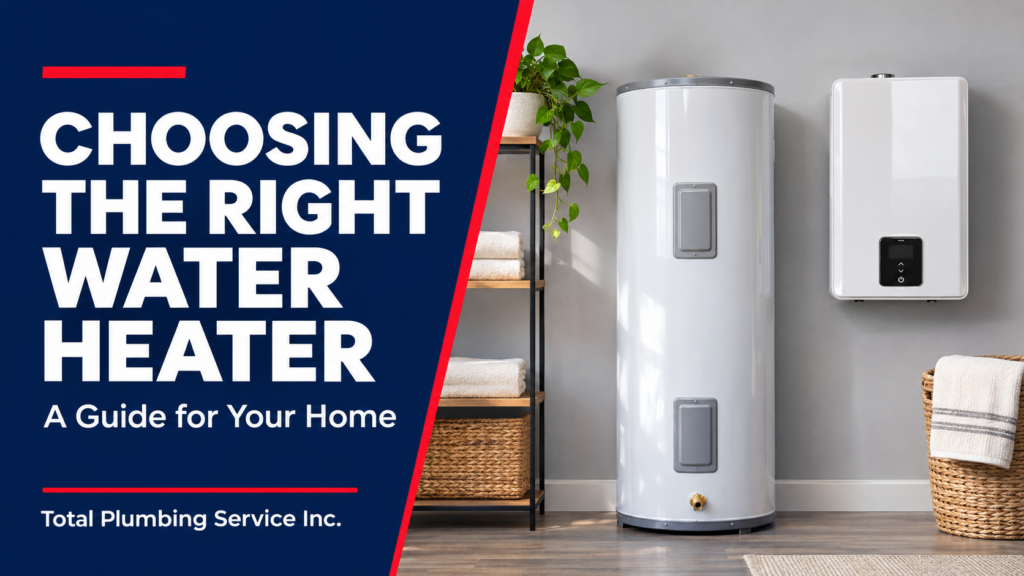
The right water heater should handle your household’s busiest hot-water periods, work with your home’s fuel supply and installation space, and fit your budget for both installation and ongoing operation. Choosing between a tank, tankless, or heat pump water heater starts with how your household actually uses hot water—not just the number of people living there.
Maybe your morning shower turns cold before you finish. Perhaps your current water heater is leaking, or you are planning ahead before an older unit fails. Whatever brings you to the decision, replacing your water heater is an opportunity to solve the problems you have now.
This guide from Total Plumbing Service Inc. explains how to compare water heater types, understand sizing, evaluate installation requirements, and ask the right questions before buying a replacement.
Before choosing a replacement, describe what you want to improve. “We need more hot water” can mean several different things, and they do not all require the same solution.
A larger water heater will not necessarily fix every hot-water complaint. For example, a faulty heating element or mixing valve can reduce performance even when the heater is correctly sized.
If your current equipment has suddenly stopped keeping up, a water heater repair evaluation can help determine whether the problem is capacity or a repairable fault.
Before your appointment, note:
A household of four that spreads out showers can have different needs from a household of four getting ready within the same hour.
The main options many homeowners compare are conventional storage tanks, tankless water heaters, and heat pump water heaters. Each can be a good fit when properly selected and installed.
A tank water heater stores heated water so it is ready when you open a faucet. Models commonly use natural gas or electric resistance heating.
A conventional tank may be a practical choice when you want a straightforward replacement and your existing setup already meets your household’s needs.
However, the stored supply is finite. Once it is depleted, the heater needs time to heat incoming cold water. Tank capacity and recovery performance both affect how well it handles a busy morning.
Replacing a tank with a similar model can simplify a project, but the installation still needs to be evaluated for fit, connections, venting where applicable, and current requirements.
A tankless water heater heats water as it flows through the unit rather than maintaining a large stored supply.
Tankless may be worth considering when you want to support longer periods of hot-water use and your home can accommodate the required installation.
The important limitation is flow capacity. A properly sized tankless unit can provide ongoing hot water within its rated output, but it cannot supply an unlimited number of fixtures at once.
Gas tankless installations may require changes to gas piping, venting, electrical connections, or condensate drainage. Whole-home electric tankless systems can require substantial electrical capacity. Neither should be assumed to be a simple swap for an existing tank.
A heat pump water heater uses electricity to move heat from surrounding air into stored water. Many models are called hybrid electric water heaters because they also have electric resistance elements to assist when needed.
A heat pump model may be worth comparing when reducing electricity use is a priority and the installation location meets the manufacturer’s requirements.
Unlike a conventional electric tank, a heat pump unit needs suitable airflow, operating temperatures, condensate drainage, and service clearance. It also produces fan and compressor noise and cools the surrounding air while operating.
ENERGY STAR provides additional information about heat pump water heater technology. Whether one fits your home requires a site-specific evaluation.
| Type | Potential advantage | Main consideration |
|---|---|---|
| Gas storage tank | May offer a practical replacement where suitable gas service and venting already exist. | Stored capacity, recovery performance, combustion air, and venting. |
| Electric resistance tank | Can be a straightforward option where an appropriate electrical circuit is available. | Recovery performance, electrical requirements, and operating cost. |
| Gas tankless | Supports extended hot-water use within its rated flow capacity. | Output at the required temperature rise, gas supply, venting, and maintenance. |
| Electric tankless | Compact equipment without a large storage tank. | Potentially substantial electrical service and circuit requirements. |
| Heat pump / hybrid electric | Can use less electricity than conventional electric resistance heating. | Airflow, room temperature, drainage, noise, and operating mode. |
Size a tank water heater for peak-hour demand. Size a tankless water heater for simultaneous hot-water flow and the required temperature rise.
These are different measurements, which is why a simple “gallons per person” rule is not enough.
The tank’s gallon capacity tells you how much water it stores. Its first-hour rating estimates how much hot water it can deliver during an hour that starts with a fully heated tank, including water heated during that period.
Two heaters with similar tank capacities can have different first-hour ratings. That difference matters when multiple people shower close together.
Ask your plumber to compare your busiest hour of demand with the proposed model’s first-hour rating. Include bathing, large tub fills, and other hot-water uses that realistically overlap.
Do not automatically buy the same tank size if your old system never met your needs. On the other hand, replacing a functioning, adequately sized system with a much larger tank may add cost without solving a meaningful problem.
Tankless sizing depends on how much hot water you need at once and how much the incoming water must be heated.
For example, heating incoming water from 50°F to an outlet temperature of 120°F requires a 70°F temperature rise. This is an illustrative calculation, not a measurement of your home’s incoming water.
A unit’s advertised maximum gallons per minute may apply at a lower temperature rise. Ask for its performance at the conditions used to design your installation, including colder-season incoming water.
The U.S. Department of Energy explains this relationship between flow and temperature rise in its gas tankless water heater guidance.
Fixture flow also needs careful interpretation: a shower normally mixes hot and cold water, so its total flow is not always the same as the flow through the water heater. A proper sizing calculation accounts for that.
Heat pump water heaters also use storage tanks and first-hour ratings. However, recovery and energy use can change with operating mode and surrounding temperature.
Ask whether the proposed model can handle your routine demand efficiently or is likely to rely heavily on backup electric resistance heating. Storage capacity should support both comfort and the way you plan to operate the equipment.
A water heater can look ideal online and still be a poor fit for the available installation space.
Before selecting equipment, have the following evaluated:
For heat pump equipment, airflow and room conditions are especially important. A small enclosed closet may require a different installation approach than an open utility area.
For gas tankless equipment, an existing gas connection does not automatically mean the supply can support the new unit along with the home’s other gas appliances.
A professional water heater replacement evaluation helps identify these requirements before equipment is purchased.
The best value depends on installation cost, energy use, maintenance, and how well the system meets your needs. The least expensive unit to buy is not automatically the least expensive to own.
Review the EnergyGuide label and the assumptions behind its estimated annual cost. Your actual expense will depend on local energy rates, usage, settings, and installation conditions.
Uniform Energy Factor, or UEF, is an efficiency measure. Compare it within the appropriate usage category rather than assuming every UEF number is directly interchangeable. A higher efficiency rating alone does not establish whether gas or electricity will cost less in your home.
If you are comparing an upgrade with a basic replacement, ask for a realistic savings estimate using your energy rates. Include maintenance costs and avoid assuming the upgrade will pay for itself within a particular number of years.
Mineral scale can affect water-heating equipment. Ask about your water conditions, the manufacturer’s maintenance recommendations, and whether treatment is appropriate.
Tankless systems may need periodic descaling. Storage tanks have their own maintenance requirements, and heat pump models typically have air filters that need attention.
The correct service schedule depends on the equipment, usage, and water quality. A general-purpose filter does not necessarily remove hardness minerals, so ask what a proposed treatment system actually addresses.
North Texas homeowners should consider freezing weather when equipment or connected piping is located outdoors or in unconditioned spaces.
Ask how exposed piping will be protected and what the manufacturer requires during freezing conditions or power outages. Built-in freeze protection may depend on electrical power and may not protect all external piping.
Attics and garages can present temperature, access, drainage, and service-clearance challenges. The fact that an older heater is installed in a location does not mean every replacement technology belongs there.
Have the proposed model evaluated for the actual space instead of selecting equipment based only on its advertised efficiency.
Not necessarily. A new water heater can improve heating capacity, but the wait at a distant faucet often depends on the piping between the heater and that fixture.
Tankless means water is heated on demand at the unit; it does not automatically mean instant hot water at every faucet.
If waiting is your main complaint, discuss the distribution piping and whether a properly designed recirculation system or another approach makes sense. Include any added energy use, controls, and installation work in the comparison.
There is no single size that fits every family of four. Shower duration, simultaneous use, bathtub size, and recovery performance all matter. For a tank, compare peak-hour demand with first-hour rating. For tankless, calculate simultaneous demand and temperature rise.
Tankless can be a good fit for extended hot-water use, but it has flow limits and may require more installation work. A properly sized tank can provide dependable performance with a simpler replacement project. Compare both against your home’s requirements.
Possibly, but the electrical requirements can be substantially different. A whole-home electric tankless unit may require multiple circuits and an electrical service or panel upgrade. Have the electrical capacity evaluated before purchasing equipment.
No. Most residential heat pump water heaters store heated water in a tank. They use heat from surrounding air to heat that water. Tankless units heat water as it passes through the equipment.
No. Brand reputation matters, but the specific model, correct sizing, installation quality, service availability, and warranty terms are also important. Compare equipment that meets your household’s needs rather than choosing only by the name on the tank.
Not automatically. Reduced hot-water performance may come from a repairable equipment problem or a change in household demand. An evaluation can help determine whether repair, resizing, or a different system is appropriate.
The right water heater should fit your household’s routine and your home’s installation requirements. You should know what capacity you are buying, what the installation includes, and what maintenance to expect.
Total Plumbing Service Inc. is a family-owned company established in 1996, providing water heater services throughout Rowlett and surrounding North Texas communities.
We help homeowners with water heater repair and replacement in Dallas and serve nearby communities including Rockwall and Frisco.
Whether you are replacing a failing tank or exploring a different setup, we can evaluate your current system and discuss suitable options.
Request water heater service from Total Plumbing Service Inc. to take the next step toward dependable hot water.