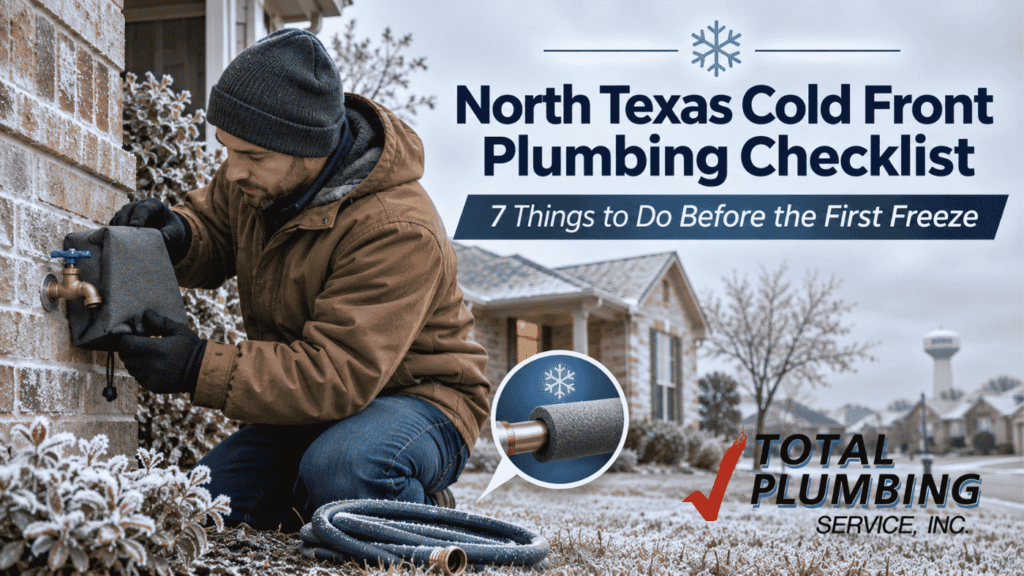
Cold fronts are starting to make their way back into North Texas, and that means homeowners across Dallas-Fort Worth should start thinking about something we don’t have to worry about for most of the year: freezing temperatures and frozen pipes.
North Texas winters can be unpredictable. We can have a warm afternoon followed by temperatures near or below freezing just a day or two later. Those quick temperature swings can be especially hard on plumbing systems that aren’t prepared for extended cold.
The good news is that you don’t have to wait until a freeze warning is issued to start protecting your home.
In fact, the best time to prepare your plumbing for winter is before the first hard freeze arrives.
A few simple checks now can help reduce the risk of frozen pipes, burst water lines, damaged outdoor faucets, water heater problems, and expensive water damage later in the season.
Total Plumbing Service Inc. has served North Texas homeowners since 1996. Here are seven things we recommend homeowners check before temperatures really begin to drop.
If you want an additional cold-weather resource to save for later, read our guide on how to prepare your North Texas home for a freeze.
People sometimes assume frozen pipes are mainly a problem in northern states.
That isn’t necessarily true.
Homes in colder climates are generally designed with prolonged freezing temperatures in mind. Plumbing may be routed differently, homes may have greater insulation in certain areas, and homeowners are accustomed to winterizing their properties every year.
North Texas homes are built for a much warmer climate.
That means some plumbing may be located in areas that become vulnerable when temperatures suddenly fall below freezing.
Common problem areas include:
Exterior walls
Garages
Attics
Crawl spaces
Outdoor kitchens
Hose bibbs and exterior faucets
Unheated utility spaces
Plumbing near poorly insulated sections of the home
A short freeze may not cause any problems.
But when temperatures remain below freezing for several hours—or when North Texas experiences one of our occasional prolonged winter storms—the risk increases.
That’s why preparation matters.
For more cold-weather information, we also have a detailed guide covering frozen pipes and burst pipes from a master plumber’s perspective.
There isn’t one exact temperature at which every water pipe suddenly freezes.
A pipe’s risk depends on:
Outdoor temperature
Length of the freeze
Wind exposure
Insulation
Pipe material
Pipe location
Indoor temperature
Air leaks around the plumbing
Generally, the longer temperatures remain below freezing, the greater the concern.
An exposed pipe in an unheated garage can be much more vulnerable than a pipe located inside a conditioned interior wall.
That’s why homeowners should focus on location and exposure, not just the number on the thermometer.
This is one of the easiest things you can do, and it takes less than a minute.
Disconnect all garden hoses from exterior faucets before freezing temperatures arrive.
A garden hose can hold water against the faucet and plumbing connection.
If that water freezes and expands, additional pressure can develop inside the faucet or connected water line.
Even if the faucet itself appears fine from the outside, damage can sometimes occur farther back inside the wall.
Then, when temperatures rise again, the damaged pipe may begin leaking.
Before winter:
Remove garden hoses
Drain water from hoses
Store hoses somewhere protected
Check exterior faucets for dripping
Inspect visible plumbing for damage
If an outdoor faucet already leaks or feels loose, it’s better to repair it before freezing weather arrives.
Insulated faucet covers can provide an extra layer of protection for exposed outdoor faucets.
They’re inexpensive and easy to install.
However, a faucet cover shouldn’t be treated as a substitute for correcting damaged plumbing or protecting vulnerable water lines.
Think of it as one additional layer of protection.
The next thing homeowners should do is identify any plumbing that may be exposed to colder temperatures.
Start with areas that don’t receive as much heat as the rest of your home.
Look in:
Garages
Attics
Crawl spaces
Mechanical rooms
Exterior utility closets
Outdoor kitchens
Areas around exterior walls
If you can see water lines in these locations, determine whether they are properly protected.
Pipe insulation can help reduce heat loss and provide additional protection from cold temperatures.
The type of insulation and installation method depends on the pipe and location, but the important thing is recognizing vulnerable areas before the weather becomes an emergency.
You can also review our older guide to winterizing plumbing and insulating pipes for additional preparation ideas.
If your home experienced a frozen pipe during a previous winter, that area should be one of the first places you check.
A pipe that froze before may still be vulnerable for the same reason:
Insufficient insulation
Cold air entering the area
Plumbing located too close to an exterior wall
Lack of heat circulation
Exposed piping
Unless the underlying problem was corrected, the same section may freeze again.
This may be the most important thing on the entire list.
Every homeowner should know how to shut off the main water supply to the house.
If a pipe bursts, the amount of water damage can depend heavily on how quickly the water is turned off.
Imagine a water line breaks inside a wall during the middle of the night.
If you know where the shutoff valve is, you may be able to stop the water in minutes.
If you don’t know where it is, you could spend valuable time searching while water continues entering the house.
Before winter arrives:
Locate your main water shutoff
Make sure it is accessible
Make sure adults in the home know where it is
Keep the area around it clear
You should also know how the valve operates.
Some homes use a lever-style shutoff, while others may have a different type of valve.
This is something we see too often.
A homeowner knows there is a shutoff valve somewhere, but they’ve never actually found it.
Then a plumbing emergency occurs and everyone is scrambling.
Take five minutes today and locate it.
That five minutes could make a big difference later.
For homeowners who want another layer of protection while away from home, a smart water monitor and automatic leak-detection system can monitor unusual water activity and provide alerts.
One of the most common questions we hear every winter is:
“Should I drip my faucets when it freezes?”
The answer depends on the home, plumbing layout, severity of the freeze, and which pipes are vulnerable.
Allowing a small amount of water to move through vulnerable plumbing may help in certain situations, particularly during severe or prolonged freezing temperatures.
But dripping faucets should not be your only winterization strategy.
You should still:
Protect exposed plumbing
Keep the home heated
Disconnect exterior hoses
Protect outdoor faucets
Know where your shutoff valve is
In other words, leaving a faucet dripping isn’t a magic shield against frozen pipes.
Our guide on preparing your home for North Texas winter weather covers additional precautions homeowners can take when a freeze is actually approaching.
Plumbing located near exterior walls or areas that have frozen previously may deserve the most attention.
During extreme cold, opening cabinet doors beneath sinks along exterior walls may also allow warmer household air to circulate around the plumbing.
Just make sure cleaning products and chemicals remain safely out of reach of children and pets.
Your water heater works year-round, but winter can put additional demand on the system.
When incoming water becomes colder, your water heater has to work harder to bring that water up to the desired temperature.
At the same time, households may use more hot water for:
Longer showers
Baths
Laundry
Dishwashing
Holiday guests
General cleaning
If your water heater is already struggling, colder weather can make the problem more noticeable.
Pay attention if you notice:
Hot water running out faster than usual
Inconsistent water temperatures
Water that doesn’t get hot enough
Popping or rumbling sounds
Discolored hot water
Water around the bottom of the tank
Frequent ignition or pilot problems
An older system requiring repeated repairs
These symptoms don’t automatically mean you need a new water heater.
Some problems can be repaired.
If your system is acting up, learn more about our professional water heater repair services.
If the tank itself has failed or the equipment has reached the point where replacement makes more sense, you can also review our water heater replacement services.
The important thing is addressing the issue before the system stops working completely during cold weather.
Tankless water heaters don’t have a large storage tank, but that doesn’t mean they are maintenance-free.
Tankless equipment may require periodic flushing or descaling depending on water conditions and manufacturer recommendations.
Exterior-mounted equipment and associated piping may also require specific freeze protection.
Follow the manufacturer’s instructions and have the system professionally evaluated if you’re unsure how your particular equipment should be protected.
You can compare traditional and tankless options on our water heater services page.
Winter isn’t the time to ignore an existing plumbing leak.
If you already have:
A dripping outdoor faucet
A leaking supply line
A running toilet
An unexplained high water bill
Low water pressure
Water around your foundation
Get it checked before colder weather arrives.
Existing plumbing problems can become more complicated during winter.
Total Plumbing Service Inc. provides professional water leak detection and repair when the source of a leak isn’t obvious.
For homeowners dealing with more complicated hidden leaks involving water, sewer, or gas systems, you can also learn more about our professional leak detection services.
One of the easiest ways to check for a hidden water leak is with your water meter.
First, turn off everything using water.
That includes:
Faucets
Toilets
Washing machines
Dishwashers
Irrigation
Ice makers if actively filling
Other water-using equipment
Then check the water meter.
If it continues showing water usage when nothing should be running, you may have a hidden leak.
That doesn’t automatically mean you have a slab leak.
The leak could be:
A running toilet
An irrigation problem
An underground water line
A plumbing fixture
A leak beneath the slab
If the symptoms point toward plumbing underneath the foundation, our slab leak detection and repair services can help determine whether a leak exists and where it is located.
Professional diagnosis can help determine where the water is going before recommending a repair.
When a freeze is actually in the forecast, you don’t want to start from scratch.
Have a simple checklist ready.
Before temperatures fall:
Disconnect exterior hoses.
Protect vulnerable outdoor faucets.
Check exposed pipes.
Keep the home heated.
Open appropriate sink cabinets if needed.
Know where the water shutoff is.
Follow appropriate faucet-dripping precautions for your plumbing.
Check on vulnerable areas during prolonged cold.
If you’re leaving town during winter weather, additional preparation may be appropriate.
Bookmark our North Texas freeze preparation guide so you have it available when the forecast calls for a hard freeze.
Sometimes the first sign is obvious.
You turn on a faucet and nothing comes out.
Other symptoms may include:
Very little water from a faucet
Sudden loss of water pressure
One fixture losing water while others still work
Frost on exposed piping
A toilet that won’t refill
Unusual noises from plumbing
If this happens during freezing weather, a frozen pipe is one possibility.
For a deeper explanation of what happens once plumbing freezes, read Frozen Pipes or Pipe Burst? Advice From a Master Plumber.
If you suspect a frozen pipe, proceed carefully.
The most important thing to understand is this:
A frozen pipe may already be damaged even if you don’t see water leaking.
Ice can temporarily block water from escaping through a crack.
Once the pipe thaws, the leak may begin.
That means you should know where your main water shutoff is and be prepared to use it.
Never use:
A propane torch
Lighter
Candle
Open-flame heater
to thaw a frozen pipe.
Open flames create a serious fire hazard and may damage the plumbing.
If an accessible pipe can safely be warmed, gradual warming is preferable.
But if you can’t identify the frozen section or suspect the pipe may already be damaged, it’s safer to call a licensed plumber.
The thawing period is when some homeowners discover they actually had a pipe failure.
During the freeze, ice may block a crack.
After temperatures rise, water begins flowing again—and suddenly the damaged section starts leaking.
That’s why homeowners should inspect the home after a hard freeze even if everything seemed fine during the coldest part of the storm.
Look for:
Wet walls
Ceiling stains
Damp cabinets
Water around exterior walls
Wet flooring
Water around the foundation
Running-water sounds
Reduced water pressure
If you see unexplained water, act quickly.
Our water leak detection team can help locate leaks that aren’t immediately visible.
If a water line bursts:
Shut off the main water supply immediately.
Then:
Open a faucet to help relieve remaining pressure
Move belongings away from the affected area
Use towels or containers where appropriate
Call a licensed plumber
Contact water-remediation professionals if significant water damage has occurred
Do not restore the water supply until the damaged plumbing has been addressed.
If you need professional plumbing service, you can request service online.
Winter plumbing problems aren’t limited to water lines.
The holiday season can also be one of the busiest times for kitchens, bathrooms, and drain systems.
More people in the house means more:
Toilet usage
Showers
Laundry
Dishwashing
Food preparation
Garbage disposal use
That can expose existing drainage problems quickly.
Call attention to:
Multiple slow drains
Toilets that gurgle
Water backing into tubs or showers
Recurring main-line stoppages
Sewer odors
Frequently clogged toilets
If several fixtures are affected at once, the issue may involve the main sewer line rather than a single drain.
Professional drain cleaning and stoppage removal may restore flow when the problem is a blockage.
If inspection reveals damaged piping rather than a simple clog, learn more about our sewer line repair services.
A sewer camera inspection may help determine whether you’re dealing with a blockage, root intrusion, aging cast iron, damaged piping, or another problem.
Homes with older sewer systems may also benefit from our guide to cast-iron sewer pipes, warning signs and replacement options.
And if the problem is an unexplained odor rather than a backup, read Why Does My House Smell Like Sewer?.
One of the biggest mistakes homeowners make is waiting until the first major freeze is already happening.
By then:
Stores may be sold out of faucet covers
Plumbers may be handling emergency calls
Outdoor plumbing may already be frozen
You may be dealing with a problem instead of preventing one
Most winter plumbing preparation is simple.
The key is doing it early.
Before the first hard freeze, make sure you can check off the following:
Garden hoses disconnected
Outdoor faucets inspected
Exposed pipes protected
Main water shutoff located
Everyone knows how to turn off the water
Existing plumbing leaks addressed
Water heater checked
Vulnerable plumbing identified
Freeze plan established
Holiday travel precautions considered
Save this checklist and run through it whenever a significant cold front is expected.
You can also reference our 7 Plumbing Tips for Winter for another quick cold-weather checklist.
You don’t need a plumber simply because colder weather is coming.
But it may be smart to schedule service if you have:
A leaking outdoor faucet
Exposed or damaged piping
Previous frozen-pipe problems
An unreliable shutoff valve
Low water pressure
An unexplained high water bill
A water heater that is struggling
Signs of a hidden water leak
Recurring sewer backups
Fixing those problems before a winter storm is usually much easier than dealing with them during one.
You can view our full range of residential plumbing services if you’re unsure which type of service your home needs.
North Texas may not experience months of freezing temperatures, but it only takes one strong winter storm to cause serious plumbing damage.
The most important thing homeowners can do is prepare early.
Disconnect your hoses.
Protect vulnerable plumbing.
Check your water heater.
Know where your shutoff is.
Pay attention to existing leaks.
And when freezing temperatures finally arrive, you’ll already have a plan.
A few simple steps today can help reduce the risk of waking up to frozen pipes, a burst water line, or a flooded home later this winter.
If you’re concerned about your plumbing before the next North Texas freeze, Total Plumbing Service Inc. can help.
Our licensed plumbers provide professional:
Frozen and burst pipe repair
Water-line repair
Tankless water heater service
Sewer camera inspections
General plumbing repairs
Total Plumbing Service Inc. has served homeowners throughout the Dallas-Fort Worth Metroplex since 1996.
Looking for a plumber in your area? Learn more about our local plumbing services in:
Whether you’re preparing your home before freezing temperatures arrive or dealing with plumbing damage after a winter storm, we’ll diagnose the problem, explain your options, and help determine the right repair for your home.
Request plumbing service from Total Plumbing Service Inc. before the next North Texas freeze.
If Atmos has turned off your gas due to a leak, don’t wait to schedule repairs. The sooner the leak is identified and repaired, the sooner you can begin the process of restoring your gas service.
The licensed plumbers at Total Plumbing are here to help with professional gas leak detection, gas line repairs, pressure testing, and code-compliant solutions throughout the Dallas-Fort Worth area.
Contact Total Plumbing today to schedule your gas leak inspection and get your home safely back up and running.