Water Heater Leaking From the Bottom? Causes and What to Do Next
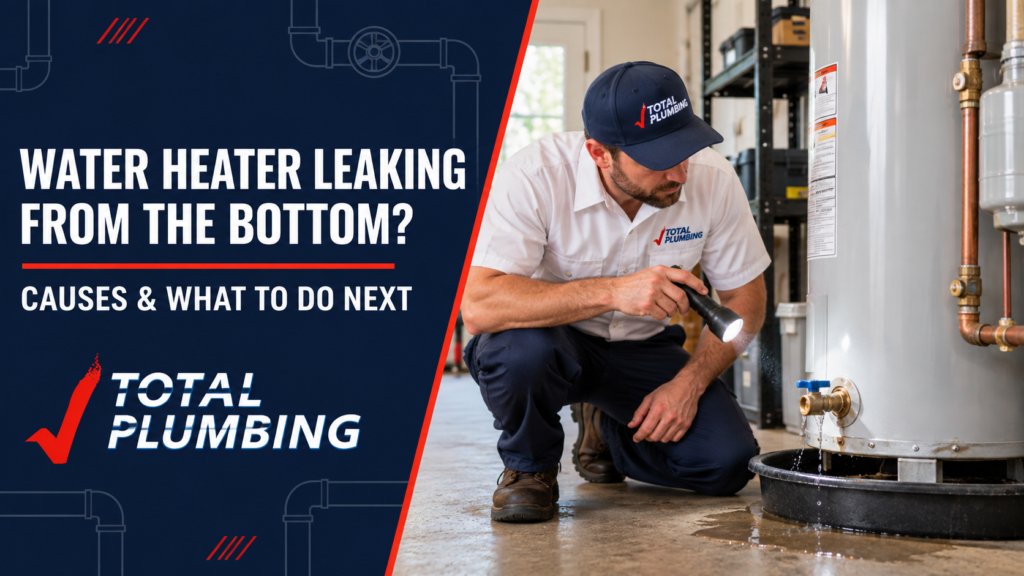
Finding water around the bottom of your water heater can be alarming. Some leaks come from a repairable valve or plumbing connection, while others indicate that the tank has corroded and needs to be replaced.
If your water heater is leaking from the bottom, do not ignore it. Even a small amount of water can damage flooring, drywall and nearby belongings. A minor leak can also become substantially worse if the tank continues deteriorating.
The first step is to limit additional water damage safely. Then you can determine whether the water is coming from the drain valve, a connection above the tank, the pressure-relief system or the tank itself.
If you discover water around your water heater, follow these steps:
1. Stay Away From Electrical Hazards
Do not step into standing water if it is near electrical wiring, outlets or appliances.
For an electric water heater, turn off the water-heater circuit breaker only if you can safely reach the electrical panel without walking through water.
If you smell gas around a gas water heater, leave the area immediately. Do not operate lights, switches or anything else that could create a spark. Contact your gas utility or emergency services from a safe location.
2. Shut Off the Water Supply
Most tank water heaters have a cold-water shutoff valve located on the pipe entering the top of the unit.
Turn the valve clockwise until it closes. If it has a lever handle, rotate the lever until it is perpendicular to the pipe.
If the valve will not close or the leak is severe, you may need to shut off the home’s main water supply. Do not force a corroded or damaged valve.
3. Protect the Surrounding Area
Move belongings away from the water heater and use towels or a wet vacuum to remove water if the area is safe to enter.
Avoid draining the tank or attempting to remove parts unless you understand the system and can do so safely. Water inside the tank may be extremely hot.
4. Schedule a Professional Inspection
A licensed plumber can identify where the leak started and determine whether the affected component can be repaired.
Total Plumbing provides professional water-heater repair and replacement throughout Dallas–Fort Worth.
Why Is My Water Heater Leaking From the Bottom?
Water collecting beneath the unit does not always mean the bottom of the tank is leaking. Water can travel down the outside of the tank from a loose connection or valve located higher on the unit.
The most common causes include the following.
1. A Leaking Drain Valve
The drain valve is located near the bottom of a traditional tank water heater. It is used to empty the tank during maintenance, repairs or replacement.
A drain valve may leak because:
- It was not closed completely
- The valve has become loose
- Mineral deposits are preventing it from sealing
- The valve or its internal components are damaged
- The valve was damaged during previous maintenance
A minor drain-valve leak may be repairable. However, replacing the valve requires the tank to be safely shut down and drained.
Do not overtighten a plastic drain valve. Excessive force can crack the valve and turn a small drip into a much larger leak.
2. A Loose Water Connection Above the Tank
The leak may be coming from the hot- or cold-water connection at the top of the water heater. Water can run down the side of the tank and collect at the bottom, making it appear that the tank itself has failed.
Look for moisture around:
- Hot-water outlet connections
- Cold-water inlet connections
- Flexible supply connectors
- Shutoff valves
- Expansion-tank connections
- Nearby plumbing fittings
A loose or deteriorated connection may be repairable if the tank remains in good condition.
3. The Temperature and Pressure Relief Valve Is Discharging
The temperature and pressure relief valve—often called the T&P valve—is an important safety component. It is designed to release water if pressure or temperature inside the tank becomes unsafe.
Water from the T&P valve normally travels through a discharge pipe terminating near the bottom of the water heater. This can make it look like the tank is leaking from underneath.
Possible causes include:
- Excessive water pressure
- Thermal expansion
- Excessive water temperature
- A faulty relief valve
- A problem with the thermostat or controls
Never plug, cap or block a pressure-relief discharge pipe. A leaking T&P valve should be evaluated because it may be responding to an unsafe condition rather than simply malfunctioning.
4. Condensation Around the Water Heater
Condensation can sometimes resemble a plumbing leak.
Moisture may form when cold water enters the tank, especially after heavy hot-water use. Condensation can also develop around venting or nearby piping under certain conditions.
A small amount of temporary condensation may not indicate tank failure. Persistent water, active dripping or a growing puddle should still be inspected.
5. Sediment Has Accumulated Inside the Tank
Minerals can settle at the bottom of a tank water heater over time. A substantial layer of sediment may contribute to popping or rumbling noises and reduce the unit’s performance.
Sediment does not always cause an external leak by itself, but long-term buildup can place additional stress on the tank and contribute to deterioration.
Maintenance recommendations depend on the water heater’s age, condition, manufacturer instructions and service history. An older unit that has never been maintained should be evaluated before it is flushed because disturbing heavy sediment may reveal existing deterioration.
6. The Inner Tank Has Corroded
Traditional water heaters contain an internal storage tank protected by a glass lining and an anode rod. Over time, the lining and protective components can deteriorate, allowing corrosion to develop.
If water is escaping through the body or bottom seam of the tank, the tank itself has likely failed. A corroded storage tank generally cannot be permanently repaired and will need to be replaced.
Warning signs of tank deterioration can include:
- Rust-colored water
- Corrosion around the tank
- Water beneath the unit
- Repeated leaking after other components are repaired
- Rumbling or popping sounds
- An aging water heater with an unknown maintenance history
Can a Water Heater Leaking From the Bottom Be Repaired?
Whether the water heater can be repaired depends on where the leak originates.
| Leak source | Repair may be possible? |
|---|---|
| Loose plumbing connection | Often |
| Damaged drain valve | Often |
| Faulty T&P valve | Sometimes, after identifying the cause |
| Expansion or pressure problem | Often, depending on the system |
| Condensation | May require adjustment or correction |
| Internal storage tank | Generally no |
| Corroded tank seam | Generally no |
A plumber should confirm the leak source before recommending replacement. Water around the bottom of the heater does not automatically prove that the storage tank has failed.
Should You Repair or Replace the Water Heater?
Repair may be appropriate when:
- The leak comes from a replaceable valve
- A plumbing connection is loose or damaged
- The unit is relatively new
- The tank is not corroded
- Replacement parts are available
- The repair is covered by the manufacturer’s warranty
Replacement may make more sense when:
- The internal tank is leaking
- Corrosion is visible around the tank
- The unit has experienced repeated problems
- The water heater is approaching or beyond its expected service life
- The necessary repair would not provide dependable long-term service
- The unit no longer meets the household’s hot-water needs
Many conventional tank water heaters last approximately 10 to 12 years, but age is only one consideration. Installation quality, water conditions, maintenance, usage and tank condition can all affect service life.
Total Plumbing offers professional water-heater replacement when repairing the existing unit is no longer practical.
Is a Leaking Water Heater an Emergency?
A leaking water heater should be addressed promptly, especially when:
- Water is spreading across the floor
- The leak is becoming worse
- Water is near electrical equipment
- The shutoff valve will not work
- Hot water is spraying from a connection
- The tank is visibly corroded or bulging
- The T&P valve is continuously releasing water
- You smell gas
- The ceiling or flooring beneath the unit is being damaged
Water heaters installed in attics, closets or upper floors can cause extensive damage when they leak. Even a slow drip can affect drywall, insulation, flooring and ceilings if it continues unnoticed.
Can You Keep Using a Leaking Water Heater?
Continuing to use the unit is not recommended until the source of the leak has been identified.
Operating a leaking water heater can allow more water to escape and may worsen an electrical, gas, pressure or corrosion problem. Turning the unit off safely and scheduling an inspection is the more responsible approach.
Do not assume the leak will stop on its own. Small leaks often become larger as components deteriorate.
How Can You Help Prevent Future Water-Heater Leaks?
Not every water-heater failure can be prevented, but routine observation and professional maintenance can help uncover problems earlier.
Homeowners should periodically look for:
- Moisture around plumbing connections
- Rust or corrosion
- Dripping from the drain valve
- Water inside the drain pan
- Unusual popping or rumbling sounds
- Inconsistent water temperature
- Changes in hot-water capacity
- Damage around the venting system
- A missing, damaged or improperly routed discharge pipe
A drain pan can help contain minor leaks, particularly when a water heater is installed in an attic or finished space. However, a drain pan is not a substitute for repairing the underlying problem.
Smart water-monitoring and automatic shutoff systems may also help identify unusual water usage and limit damage from certain plumbing leaks.
Water-Heater Repair and Replacement in Dallas–Fort Worth
A leaking water heater does not always require immediate replacement, but it does require an accurate diagnosis.
Total Plumbing Service Inc. has served North Texas homeowners since 1996. Our licensed plumbers inspect the unit, identify the source of the leak and explain whether repair or replacement is the better option.
Customers receive clear recommendations and upfront flat-rate pricing before authorizing the work. We service traditional tank and tankless water heaters throughout Dallas, Rowlett, Garland, Rockwall, Plano, Richardson, Mesquite, Frisco, McKinney, Irving and surrounding DFW communities.
If your water heater is leaking from the bottom, turn off the unit and water supply when it is safe to do so. Then schedule service with Total Plumbing before the leak causes additional damage.